
Forthcoming:
Witness Protection
Winner of the Fall 2025 Black River Chapbook Competition
Black Lawrence Press, 2027
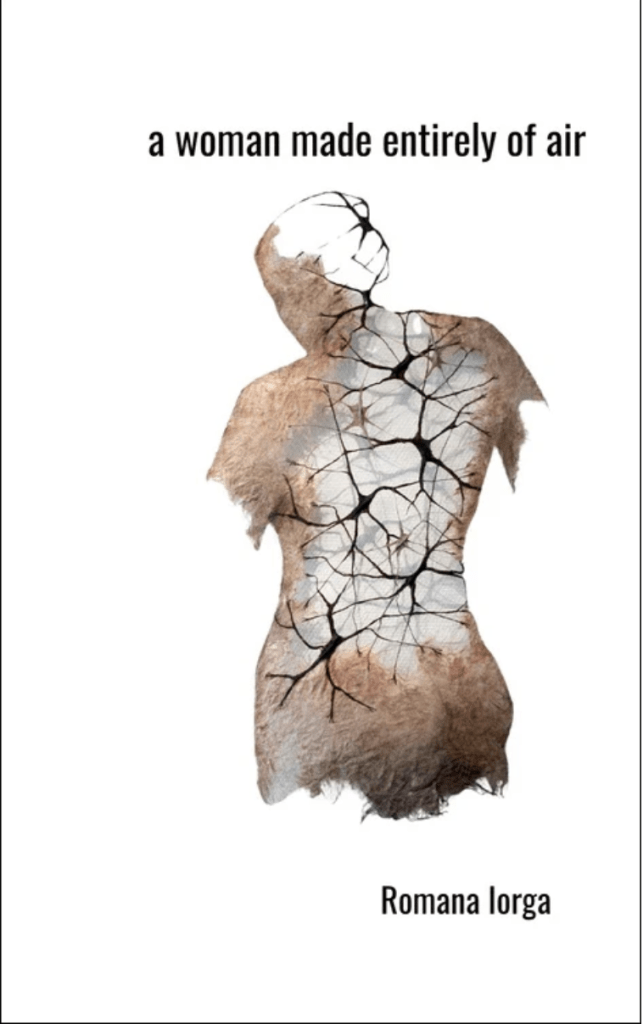
a woman made entirely of air
dancing girl press, 2025
“The poems of Romana Iorga’s searching, piercing a woman made entirely of air tremble between speech and silence, inhabiting a liminal space entirely their own: aching, tender, and true. No word is wasted in their effort to make present on the page a daughter’s complicated grief. And to the vital, insistent question of how to speak, how to live, when “silence / keeps the truth / whole,” these poems are their own vital and beautiful answer, pressing back against the beyond-words-ness they both honor and refuse.”
— Kasey Jueds, Author of Keeper and The Thicket
“In Romana Iorga’s a woman made entirely of air, a daughter mourns a mother with a grief that is as complex and oppositional as the relationship between silence and speech. Juxtaposing language’s ability to harm, memorialize, and transform with its mirror-image helplessness in the face of death, Iorga’s work is uncompromising and generous at once, moving and subtle.”
— Maureen Thorson, Author of On Dreams, Share the Wealth, My Resignation, and Apples to Oranges
“In this rivetingly poignant collection, a woman made entirely of air, Romana Iorga asks, “what / am i / if not / a boat made of flesh / carrying words from one / shore of your absence / to another?” Iorga’s delicate poems, intricately interwoven with caesuras, create a beautiful lacework of memory, trauma, and grief. These poems are a meditation on breath, breathlessness, silence, silencing, absence, and erasure. Here, Iorga seamlessly moves within the transitory, the hospice between shores, the Bardo of the in-between. These are hauntingly exquisite poems.”
— Lee Ann Roripaugh, Author of tsunami vs. the fukushima 50

Temporary Skin
Glass Lyre Press, 2024
“I’d been seeing Romana Iorga’s good poems everywhere, and when I heard she had a full-length collection on the horizon, I was (rightly it turns out!) thrilled. My first time reading Temporary Skin, I noticed what I’d noticed in all her loose poems that’d caught my eye in journals of late—a singularly uncanny voice, nudging unabashedly toward truth: “I am your eye, hums / the stone,” she writes in one poem. “There’s a nothingness / sitting at an invisible kitchen table, / drinking the void,” she writes in another. The effect of reading an entire collection of these poems is utterly unmooring—being present for a mind so furiously curious, so comfortable in its own idiom. I’ll follow Iorga’s poems anywhere.”
— Kaveh Akbar, Author of Pilgrim Bell, Calling a Wolf a Wolf, and Martyr!
“This is the history of grief,” Romana Iorga writes in this moving collection that sings not only with grief, but with silences that are their own form of song. In these poems, family histories are entangled with narratives of loss and the many ways the skin both holds and fails to hold any history for long. Gorgeously rendered, these poems also embody possibility: beyond death and life, beyond sound and silence, beyond boundaries of time and birth and physical landscapes, Iorga’s poems implore the reader to consider the temporariness of all things, even memory, as “something you could, / maybe, come home to.” This is an exquisite collection that holds instead the reader’s attention and care, as it re-envisions the ways one asks to be held inside humanity, to belong “here.”
— Chelsea Dingman, Author of Thaw, Through a Small Ghost, and I, Divided
“In Temporary Skin, Romana Iorga’s poems draw lyrically clear and poignant landscapes of loss and grief, tracking the places where the beloved was last seen—gardens in rain, cloudy cities, rooms in which people sit across from each other as if caught in a dream. One moment the beloved is there, and the next, it’s left behind only the seamless wound of its going. It may be that a broken clock “always shows the right time.” But the poet attends, as poets must, to the task of her devoted gathering.”
— Luisa A. Igloria, author of Maps for Migrants and Ghosts, and Poet Laureate of the Commonwealth of Virginia, 2020-22 (Emerita)
“In Romana Iorga’s Temporary Skin, the wound pulses, the grave beckons, the weather changes. The past is ever near, and the past is irretrievable. Folkloric, witty, and understated by turns, these poems shimmer with inventive metaphors, reversals, and self-skepticism, all of which remind us of the fundamental strangeness of existence, a strangeness we lose touch with amid the blur of the mundane. But more than that, Temporary Skin builds into a delightful exploration of the act of making itself and a meditation on language as method for restoring the fragments of our selves and our lives. “I am waiting to be returned to myself / in one piece,” Iorga writes—something we all long for, and something this collection gives us, poem by poem by poem.”
— Molly Spencer, Author of If the House, Hinge, and Invitatory
“Romana Iorga’s Temporary Skin takes up the oldest task that poetry puts before us: to use language to harness experience, and therefore more skillfully, truthfully, ride it. Richly surreal and visionary, the book tunnels darkly into nightscapes, interiority, memory, dreams. In language deft and gleaming as shards of obsidian, Iorga conjures landscapes whose trees “drop no fruit, except the knowledge of a world gone up in flames”; whose nights are “full of dark coats/ buttoned up on emptiness”; where “people and dogs [are] stuck/ up to their knees in our grief.” Trapped in the mazes and labyrinths of history, speaking from the coffin or the grave, seemingly wedded to her own damnation, our speaker still yearns to somehow hit rewind, to start over again in “a new Eden.” At the end of it all, Iorga shows us that poetry—arriving in the form of “a charm of/hummingbirds,” arriving as “a congregation/ of plovers”—is where our redemption lies.”
— Claire Wahmanholm, Author of Night Vision, Wilder, Redmouth, and Meltwater
 Romana Iorga